Please use another Browser

It looks like you are using a browser that is not fully supported. Please note that there might be constraints on site display and usability. For the best experience we suggest that you download the newest version of a supported browser:

Internet Explorer, Chrome Browser, Firefox Browser, Safari Browser

Continue with the current browser

Siemens and Stadler consortium to deliver fully automated trains for S-Bane Copenhagen

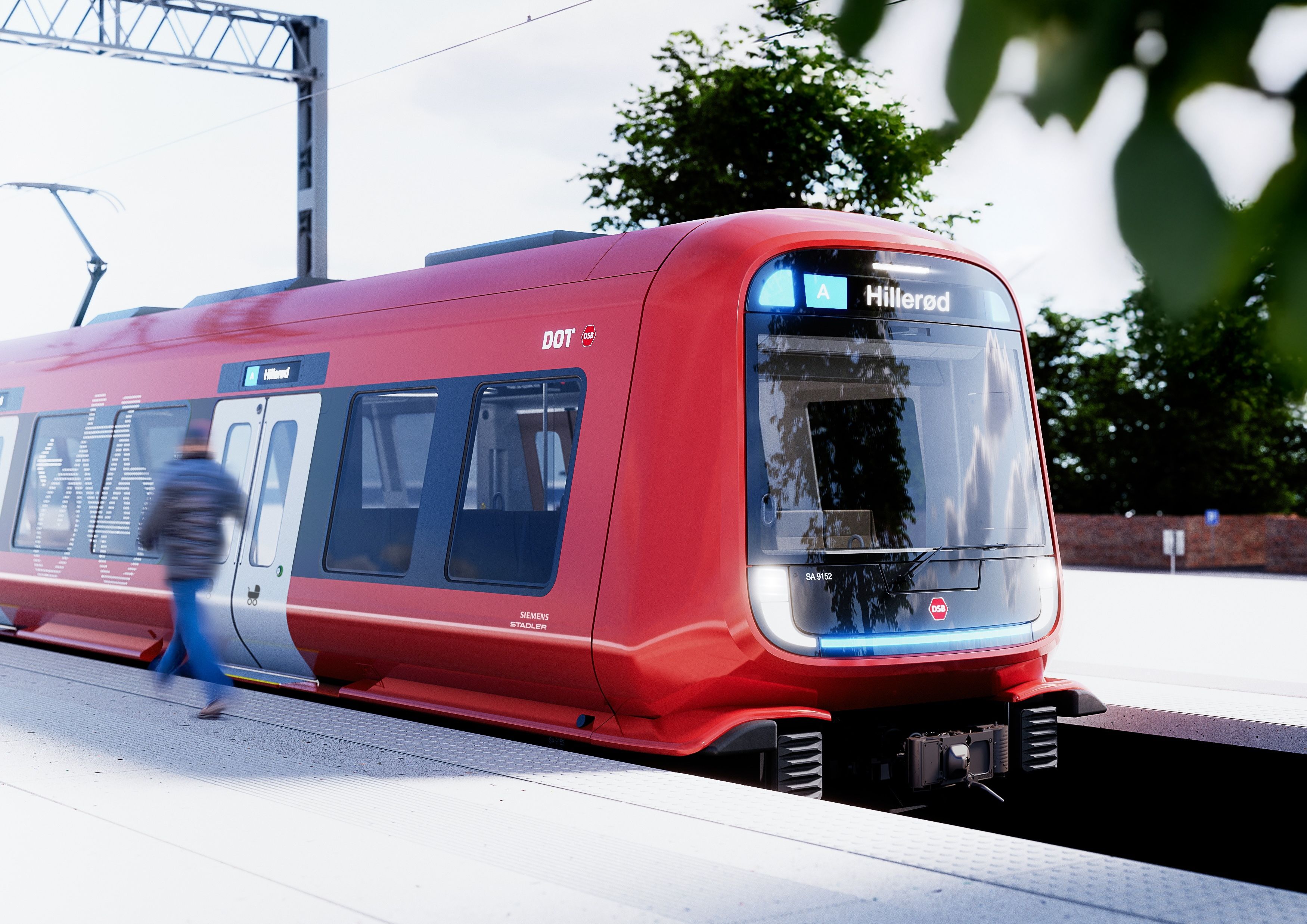
S-Bane Copenhagen: Automated, driverless trains, photo source: Siemens Mobility

The Danish State Railways (DSB) has signed a framework contract with the consortium of Siemens Mobility and Stadler for the delivery of 226 fully automated 4-car trainsets in an iconic design with an option for up to 100 further trains. The fleet creates the world´s largest open railway system with automated train operation (ATO), with the consortium volume valued in the region of three billion euros.  
Siemens Mobility, as a consortium leader, will be responsible for the electrical equipment, including the propulsion and braking systems, on-board power supply system, vehicle and train control systems, passenger information system and vehicle bogies. Stadler provides the carbodies, couplings, all interior fittings and seats, air conditioning and doors. Stadler also handles the final assembly of the trains.

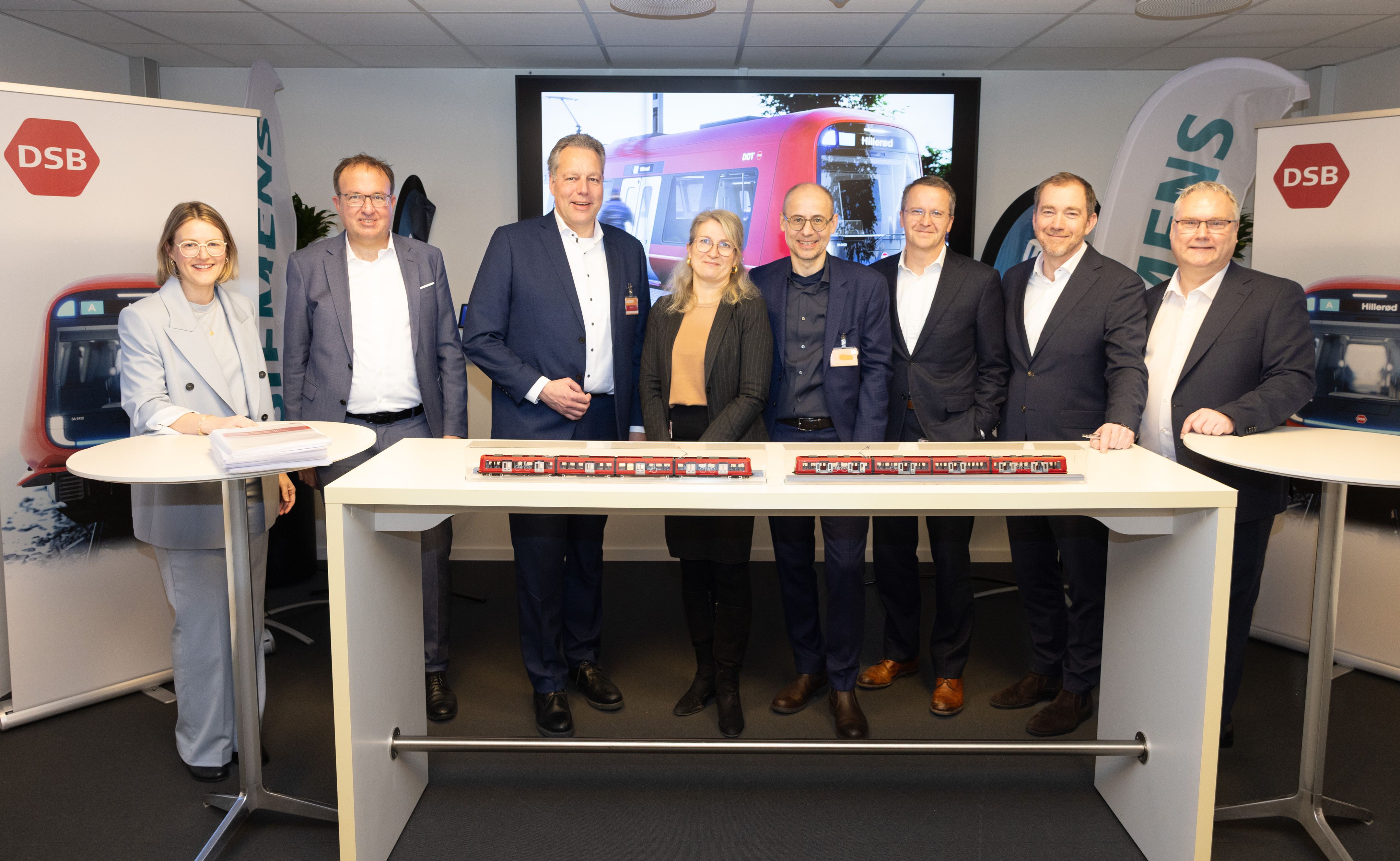
From left to right: Antonia Hoffmann, Bid Manager, Siemens Mobility; Michael Schwarz, Area Marketing & Sales Director Nordic Countries, Stadler; Ansgar Heinrich Brockmeyer, EVP Marketing & Sales and Deputy Group CEO, Stadler; Pernille Dam Nielsen, CFO, DSB; Gerry Greiter, CEO Region North-West Europe, Siemens Mobility; Jürgen Müller, Executive Vice President Strategy and Rolling Stock, DSB; Jesper Nilson, CEO, Siemens Mobility Denmark; Hans Henrik Jensen, CFO, Siemens Mobility Denmark. Photo source: Bjarke Ørsted.

Siemens Mobility also delivers a Technical Support & Spares Supply Agreement (TSSSA+) including Railigent X, a tailored service and maintenance concept, to ensure reliability and availability for at least 30 years as well as provision of complete IT requirements. The first vehicles will be ready to enter service as of 2032. Subsequently, all remaining vehicles will be delivered continuously to DSB until 2040. 
“This is the largest investment in the 90-year history of the S-Bane. With this investment, DSB takes another important step toward future proofing the capital’s public transport. Increased frequency and capacity will ensure that the S-Bane keeps up with growing demand and maintains its role as the backbone of Copenhagen’s transport network,” says Flemming Jensen, CEO at DSB. 
“Together with Stadler, we are proud to have been selected to build and maintain 226 new S‑trains for Copenhagen. This order will create the world´s largest open railway system with automated train operation. We’re not just delivering trains, but intelligent mobility solutions, including Railigent X and our innovative Air‑free Brake System, to keep Copenhagen’s public transport efficient and sustainable,” said  Michael Peter, CEO of Siemens Mobility. “Our partnership with Copenhagen is long‑standing. We are already upgrading the S‑bane network with advanced signaling for full automation by 2033 on behalf of Banedanmark and DSB, building on our previous work to increase capacity and reliability.”
“With these new trains, we are continuing the iconic design tradition of the Copenhagen S-Bane S-train. The vehicles are a good example of how design goes hand in hand with comfort and pioneering technology. Designed for fully automated operation, passengers can look forward to trains that will significantly enhance their travel experience. The order is of great strategic importance and will help us to further expand our presence in Northern Europe. We thank DSB for the order and look forward to building the trains in our proven consortium with Siemens,” says  Ansgar Brockmeyer, Head of Marketing & Sales Division and Deputy Group CEO of Stadler. 
The biggest transformation in the 90-year history of the S-Bane
With the transition to fully automated train operations, DSB aims to significantly enhance service frequency of the Copenhagen S-bahn. During peak hours, trains will run with a maximum interval of seven and a half minutes on each line and as little as one and a half minutes between trains in central Copenhagen. On several routes, this will translate to up to 35 percent more departures compared to today, creating capacity for approximately ten million additional journeys annually. In 2025, around 111 million passengers traveled on the S-Bane, and DSB expects this number to continue growing in the coming years, thus preparing the S-Bane for the future.
Innovative design, plenty of space, forward-looking technology
The design of the new S-Bane trains is innovative and deliberately stands out from other suburban trains while remaining the well-known DSB design passengers are already familiar with. This ensures a sense of continuity and comfort for regular users. The large side- and especially front-windows enhance a bright and open feeling and offer passengers a good view to the front. The vehicles are barrier-free and significantly increase passenger comfort. The 56-metre-long trains have 120 seats, 36 folding seats and around 300 standing places. This gives them sufficient capacity for the busy S-Bane service. Wide aisles and spacious entrance areas ensure smooth passenger flow even during rush hour. The ground-level entrance with sliding steps provides step-free access. Flexible multi-purpose areas with folding seats offer space for bicycles, wheelchairs and prams. An optimised exterior display of route information outside the trains, modern passenger information systems, smooth running characteristics and low noise levels further increase comfort for passengers.
The future S-Bane trains will also offer greater flexibility in interior design compared to today’s trains or similar urban rail systems in Europe. Features will include 2+2 seating configurations, air conditioning, workspaces with tables for commuters, and integrated spaces for wheelchair users. By introducing these enhancements, the future S-Bane will deliver many of the same benefits passengers associate with long-distance trains, ensuring a more comfortable, efficient, and inclusive travel experience for all.
Innovative engineered components like the Air-free Brake System from Siemens Mobility will set new standards for operational performance. This groundbreaking system achieves a significant weight reduction and reduces the associated CO₂ footprint by over 50 percent through its innovative design, which replaces complex pneumatic systems and their associated energy consumption. Coupled with a state-of-the-art propulsion system, it delivers optimal performance and precision while generating substantial operational savings. Together, these advancements make a significant contribution to more sustainable and efficient railway operations.
Comprehensive service agreement for Copenhagen S-Bane 
A 30-year service agreement with DSB, including options for two additional five-year extensions, has also been signed. This Technical Support & Spares Supply Agreement (TSSSA+) delivers an all-inclusive solution, covering everything from spare parts supply, and utilization support of DSB maintenance staff to cutting-edge cybersecurity services. The consortium will have overall responsibility for maintenance, while DSB employees will carry out the actual maintenance work. At its core is an advanced maintenance management system enhanced by innovative digital tools such as CORMAP, Railigent X, and a FRACAS/RAM reporting platform, designed to optimize maintenance planning and monitoring while boosting fleet reliability. The agreement ensures outstanding availability of Copenhagen’s S-Bane network. With comprehensive on-call support and state-of-the-art workshop equipment, Siemens and DSB will ensure safe, efficient, and punctual train operations.
Fully automated S‑Bane to boost capacity, reliability, and comfort
Siemens Mobility is also upgrading the entire 170-kilometer S-bane network in Copenhagen to the highest Grade of Automation (GoA4), enabling fully driverless operations with the CBTC solution, Trainguard MT. Announced in 2024, the signed contracts cover the delivery of all required trainborne and wayside signaling technology, including onboard equipment for 226 new trainsets. The migration to GoA4 will be carried out in five phases, with the first automated operations planned for 2030 and full automation targeted by 2033. By introducing GoA4 technology, the operator will be able to increase network capacity, improve the passenger experience, while maintaining highest level of security and Copenhagen’s strong punctuality levels, and ensure long-term resilience of the network.

For this press release

DSB is Denmark's national railway company and has been a cornerstone of Danish public transport since its founding in 1885. Headquartered outside Copenhagen, DSB provides passenger rail services across Denmark, including regional and intercity routes, as well as the S-train network in the Copenhagen metropolitan area. Each year, DSB transports over 170 million passengers, making it one of Denmark's most significant contributors to public mobility. Of those 110 million are S-train passengers. With a strong focus on sustainability and innovation, DSB is undergoing a green transformation by investing in electric trains and modernizing its fleet to reduce emissions and improve energy efficiency. The company is committed to delivering reliable, comfortable, and environmentally friendly transport solutions for millions of passengers each year. DSB employs approximately 6,000 people.
Read more
Siemens Mobility is a separately managed company of Siemens AG. As a leader in intelligent transport solutions for more than 175 years, Siemens Mobility is constantly innovating its portfolio. Its core areas include rolling stock, rail automation and electrification, a comprehensive software portfolio, turnkey systems as well as related services. With digital products and solutions, and the use of industrial AI, Siemens Mobility is enabling mobility operators worldwide to make their infrastructure intelligent, increase value sustainably over the entire lifecycle, enhance passenger experience, and guarantee availability. In fiscal year 2025, which ended on September 30, 2025, Siemens Mobility posted revenue of €12.4 billion and employed around 43,400 people worldwide. Further information is available at: www.siemens.com/mobility
Read more
Stadler has been building trains for over 80 years. The provider of mobility solutions in rail vehicle construction, service and signalling technology has its headquarters in Bussnang in eastern Switzerland. Around 17,200 employees work at eight production and six engineering sites and over 80 service locations, including around 6,000 employees in Switzerland. Stadler is the world's leading manufacturer of vehicles with alternative drive systems (hydrogen and battery) and rack railway vehicles. The company is aware of its social responsibility for sustainable mobility and therefore stands for innovative, sustainable and durable quality products.
Read more

Contact

DSB

Pressebüro

+45 2468 0000

Silke Thomson-Pottebohm

Siemens AG

+49 174 306 3307

Stadler

Jürg Grob

+41 79 771 64 83