Internet Explorer, Chrome Browser, Firefox Browser, Safari Browser
Press Release25 November 2025Siemens AGZug,
Switzerland
Siemens introduces breakthrough time synchronization to fortify digital substations
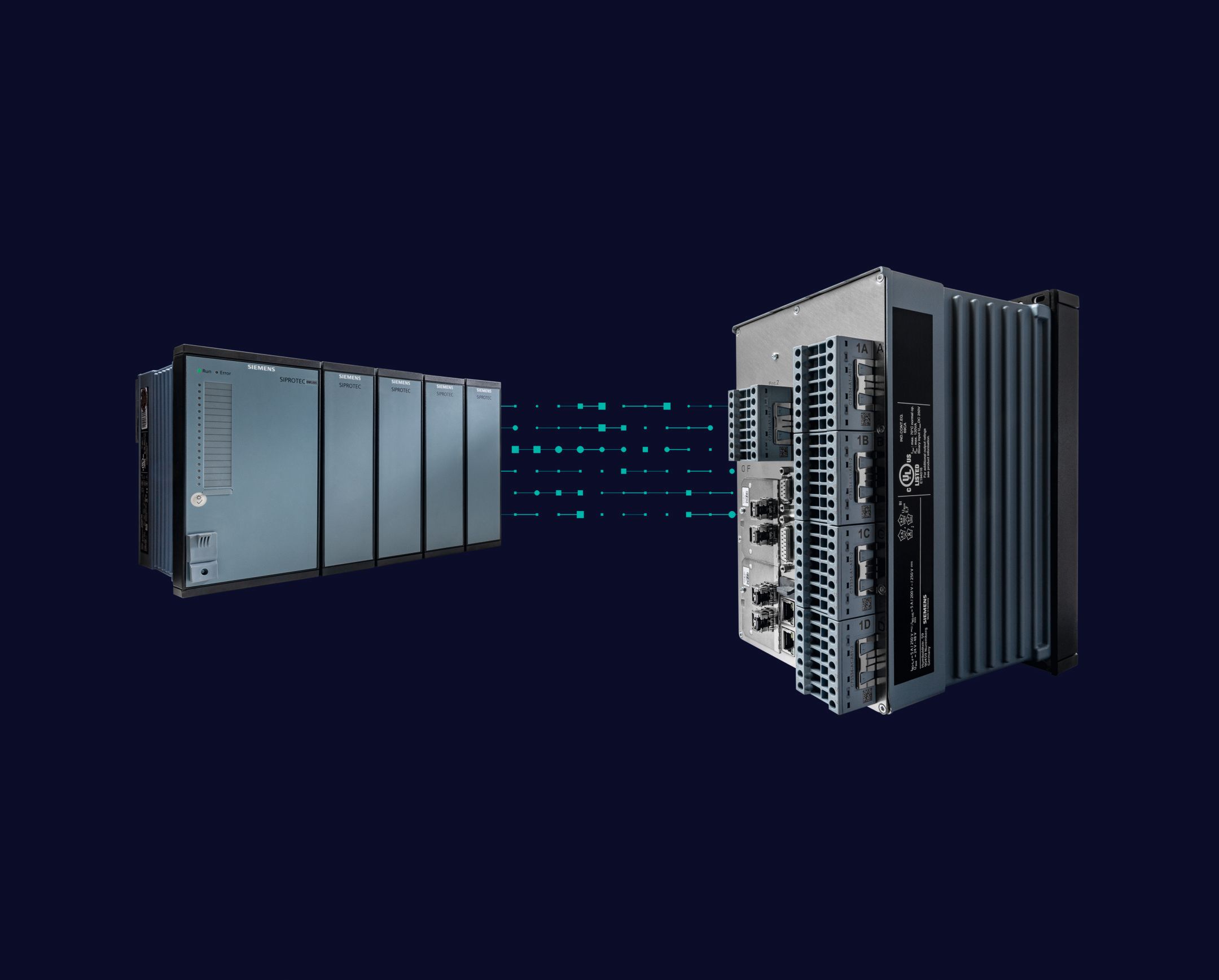
Process bus solution Siprotec 5 with Grandmaster Clock: The merging unit digitizes the measured values of the instrument transformers and transmits them as a sampled values data stream via Ethernet to the Siprotec 5 protection devices.
In today's digital power grid, precise time synchronization
is essential for protection systems. While many applications require globally
accurate time signals, sampled values within process bus systems primarily depend
on consistent local precision rather than external global sources.
Siemens' solution separates sample synchronization from
global time synchronization using specialized internal time sources. The
Siprotec 5 devices, equipped with integrated PTP Grandmaster Clocks compliant
with IEEE 1588v2/PTP standard, operate independently from external Global
Navigation Satellite System (GNSS) signals. Instead, they use internal
oscillators as time references for precise synchronization.
A key feature of this approach is Siemens' patent-pending Seamless PTP grandmaster changeover technology, built into Siprotec 5 devices. This ensures that when primary clocks return, they first align with active backup clocks before resuming their role. In doing so, disruptive time base jumps during switchovers are prevented, keeping protection functions continuously available.
The specialized synchronization enables process bus networks in
digital switchgears to operate autonomously without external access points,
significantly strengthening cybersecurity by isolating the process bus from the
station bus network.
Conventional digital substation architectures often rely on
redundant GNSS-based grandmaster clocks. However, even with redundancy, they
remain vulnerable: disturbances to GNSS signals, whether from natural phenomena
like solar storms or intentional interference such as jamming and spoofing, can
cause disruptive 'jumps' in the time base. Such disruptions force merging units
to resynchronize, temporarily disabling critical protection functions and can
lead to unnecessary removal of equipment from service or even cause false
tripping events, impacting grid stability and increasing operational costs.
Siemens' new solution mitigates these risks, ensuring uninterrupted, secure
operation.
"This technology directly addresses one of the most
critical vulnerabilities in digital substations," said Onyeche Tifase, Vice
President Product Lifecycle Management at Siemens Smart Infrastructure.
"By keeping protection functions active through any time source change and
shielding process networks from external threats, we are helping customers
operate safer, more reliable, and more sustainable power systems."
Siemens Smart Infrastructure (SI) is shaping the market for intelligent, adaptive infrastructure for today and the future. It addresses the pressing challenges of urbanization and climate change by connecting energy systems, buildings, and industries. SI provides customers with a comprehensive end-to-end portfolio from a single source – with products, systems, solutions, and services from the point of power generation all the way to consumption. With an increasingly digitalized ecosystem, it helps customers thrive and communities progress while contributing toward protecting the planet. To protect this journey, we foster holistic cybersecurity to ensure secure and reliable operations. Siemens Smart Infrastructure has its global headquarters in Zug, Switzerland. As of September 30, 2025, the business had around 79,400 employees worldwide.
Siemens AG (Berlin and Munich) is a leading technology company focused on industry, infrastructure, mobility, and healthcare. The company’s purpose is to create technology to transform the everyday, for everyone. By combining the real and the digital worlds, Siemens empowers customers to accelerate their digital and sustainability transformations, making factories more efficient, cities more livable, and transportation more sustainable. A leader in industrial AI, Siemens leverages its deep domain know-how to apply AI – including generative AI – to real-world applications, making AI accessible and impactful for customers across diverse industries. Siemens also owns a majority stake in the publicly listed company Siemens Healthineers, a leading global medical technology provider pioneering breakthroughs in healthcare. For everyone. Everywhere. Sustainably. In fiscal 2025, which ended on September 30, 2025, the Siemens Group generated revenue of €78.9 billion and net income of €10.4 billion. As of September 30, 2025, the company employed around 318,000 people worldwide on the basis of continuing operations. Further information is available on the Internet at
www.siemens.com.